Our Beloved Friends

Search

Search articles, studies, compounds, and conditions

Longevity & immune science for dogs and cats

More good years with our beloved friends.

An evidence library, not a storefront. We read the primary literature on aging in dogs and cats — rapamycin, mitophagy, senolytics, immune decline — and write down what it actually shows, including where it runs out.
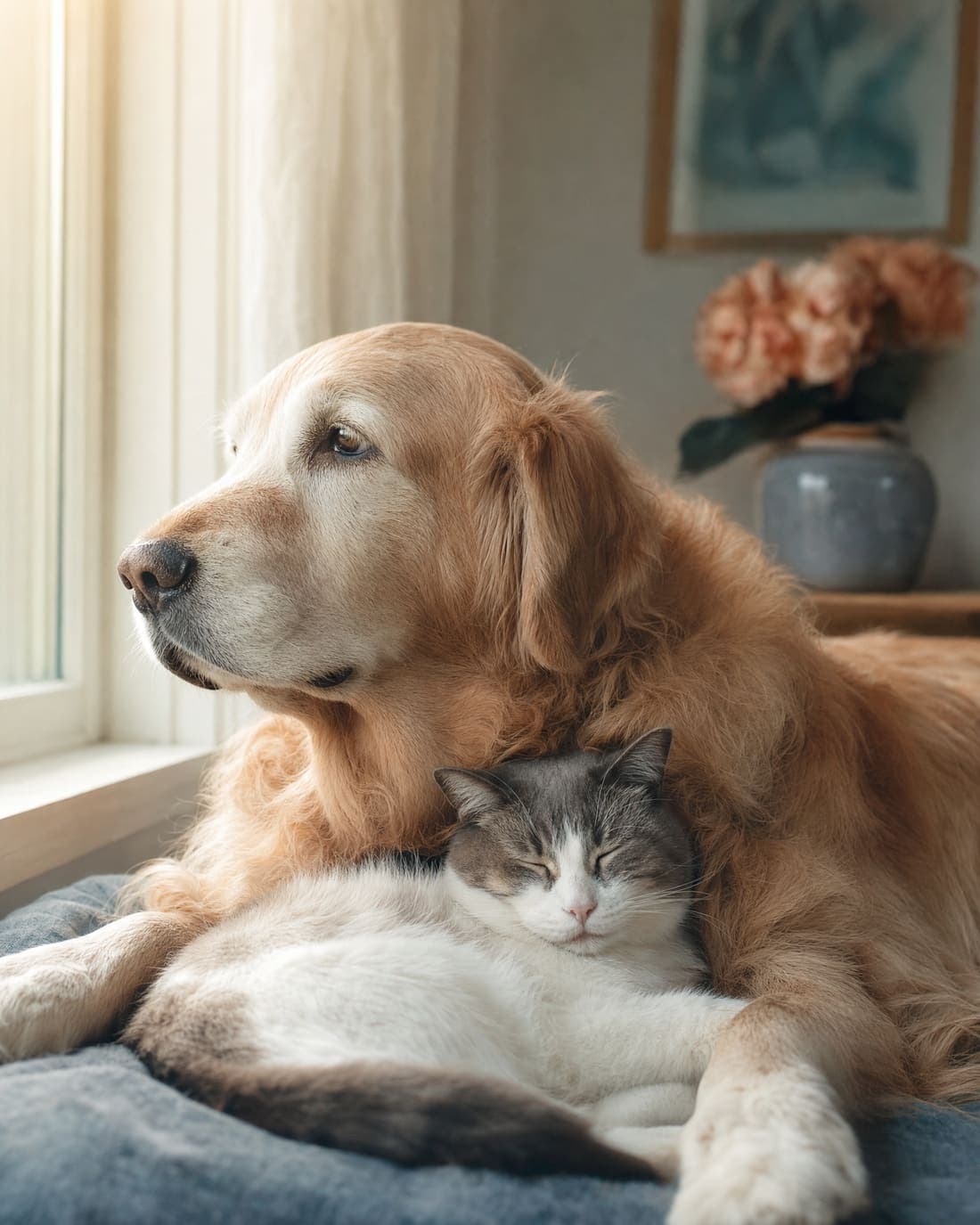
An older golden retriever resting by a sunlit window with a grey cat asleep against its chest
  • Every claim traces to a paper
  • Honest evidence stage on everything
  • Ongoing trials marked as ongoing
  • We publish the disappointing results too

Why dogs and cats

They age like us, only faster.

Aging and immune biology are largely conserved across dogs, cats, and humans. Our pets share our homes, our air, and our floors — and they run through the whole arc of a life in a decade or so. That makes them the most honest model of aging we have, and it is why serious geroscience has moved into the living room.

But conserved biology is not a blank check. Cats are not small dogs. Dose and safety are where good science becomes bad advice, and we are careful to say which is which.

How we grade the evidence →

The study library

Start with the papers themselves.

18 studies, 6 of them run in actual dogs or cats. Each one with its species, design, sample size, and an honest note on where the evidence stops.

Rapamycin & mTOREmerging evidence

A randomized controlled trial to establish effects of short-term rapamycin treatment in 24 middle-aged companion dogs

Urfer S.R., Kaeberlein T.L., Mailheau S. et al. · GeroScience, 2017

Ten weeks of low-dose rapamycin in healthy middle-aged dogs was well tolerated, with no significant increase in adverse events over placebo. Echocardiography showed improvements in age-associated measures of heart function.

Species
Dogs
Design
Randomized controlled trial
Sample
24 middle-aged companion dogs
Rapamycin & mTORAnimal-model evidence

Rapamycin fed late in life extends lifespan in genetically heterogeneous mice

Harrison D.E., Strong R., Sharp Z.D. et al. · Nature, 2009

Rapamycin started at 600 days of age — the equivalent of a 60-year-old human — extended median and maximal lifespan, by roughly 9% in males and 14% in females.

Species
Mice
Design
Preclinical / animal model
Sample
Three independent sites, NIA Interventions Testing Program
Aging cohortsEmerging evidence

An open science study of ageing in companion dogs

Creevy K.E., Akey J.M., Kaeberlein M., Promislow D.E.L. et al. · Nature, 2022

Establishes a large, open, longitudinal cohort of pet dogs — with owner surveys, veterinary records, and biospecimens — designed to identify the genetic, environmental, and lifestyle determinants of healthy canine aging.

Species
Dogs
Design
Cohort study
Sample
Tens of thousands of companion dogs across the United States

From the library

The papers, explained.

Five questions

Most of this research isn’t about your animal.

Tell us the species, the age, the weight, and what’s going on health-wise, and we’ll show you which studies actually apply — plus what should stop the conversation cold, and what to ask your vet.

Take the evidence quiz

The most important sentence on this site.

No drug has yet been shown to extend the lifespan of a dog or a cat. The trial designed to answer that question — TRIAD — is still running. Anyone who tells you otherwise is telling you something they do not know.

Straight answers

The questions everyone asks first.

Can I give my dog rapamycin?
Only a veterinarian can decide that. Rapamycin is a prescription drug, and while a small randomized trial in pet dogs found short-course low doses well tolerated, no trial has yet shown it extends a dog's life — the study built to answer that, TRIAD, is still running. Read more →
Is rapamycin safe for cats?
The evidence in cats is very thin. One controlled trial (RAPACAT) tested it in cats with subclinical heart disease and found it tolerated at the doses studied — a safety result, not proof of benefit, and not a green light. Cats metabolise drugs differently from dogs, so this is strictly a veterinary decision. Read more →
Does anything actually make dogs live longer?
The best-evidenced interventions are unglamorous and free: keeping a dog lean has an actual controlled lifespan study behind it, which is more than any longevity drug can claim in a companion animal. Dental care, muscle maintenance, and early screening all help too. Read more →
Isn't rapamycin an immunosuppressant?
At the high continuous doses used in transplant medicine, yes. At low intermittent doses, human trials show the opposite — improved vaccine response and fewer infections in older adults. Same molecule, different dose, different effect. Dose is the whole distinction. Read more →
When is my dog or cat considered senior?
For dogs it depends on size: a giant breed is senior around six, a small breed not until ten or eleven. Cats are generally mature at seven and senior at eleven. The 'multiply by seven' rule is a myth. Read more →

Have a question? Ask a vet.

Message us on WhatsApp and one of our veterinarians will help you work out whether any of this applies to your animal — and tell you plainly when the honest answer is “not yet” or “no.”

Ask on WhatsApp

A conversation, not a prescription. Anything for your pet still goes through a veterinarian who has examined them.

Follow the science.

New studies and write-ups, when there is something worth sending — including the results that disappoint.

Get research updates

New studies and write-ups, when there is something worth sending. No spam, no account.