Turkey tail: the immune mushroom with a 50-year clinical track record
PSP, PSK, TLR2, and natural-killer cells — why a shelf fungus has a longer clinical track record than most things in the supplement aisle, and where the evidence stops.
Our Beloved Friends Research · June 5, 2026 · 8 min read
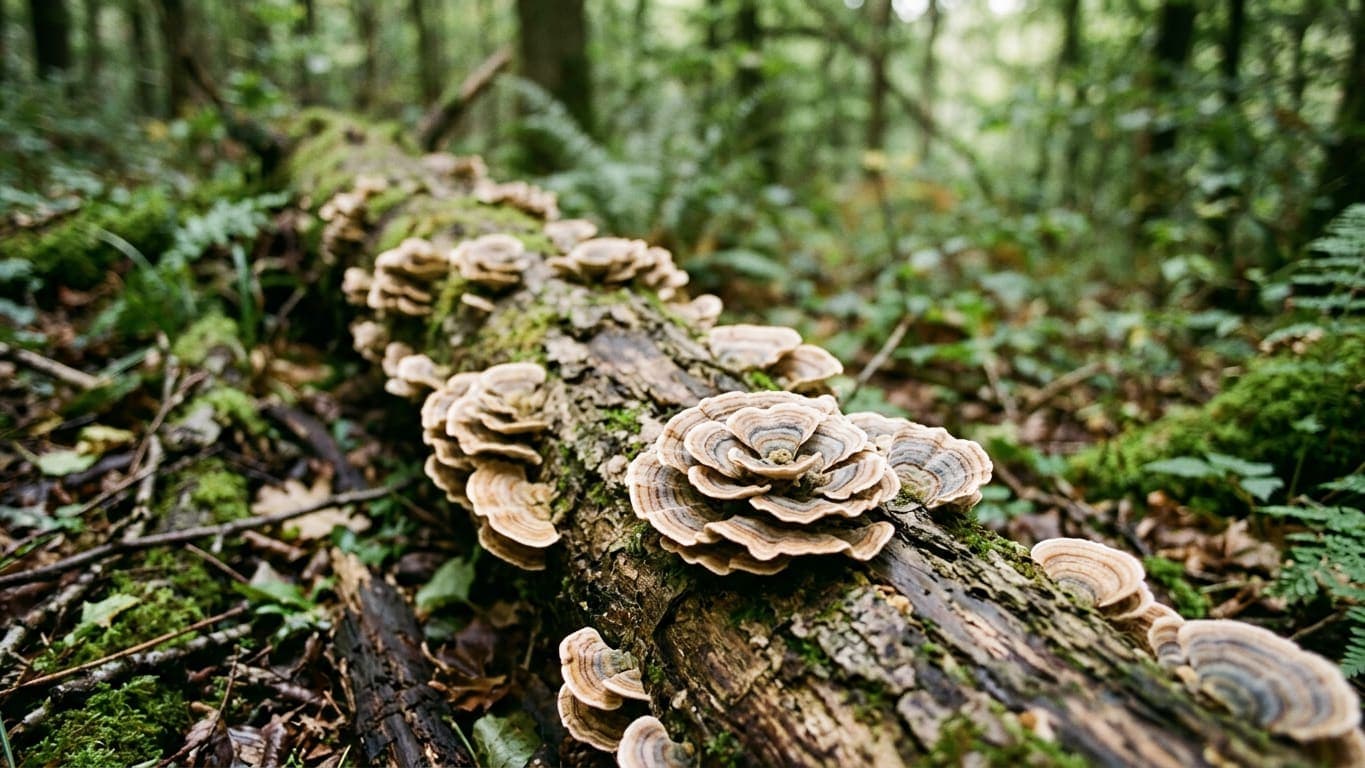
Turkey tail (Trametes versicolor, formerly Coriolus versicolor) is one of the most-studied medicinal mushrooms in the world. That is not marketing; it is a consequence of two protein-bound polysaccharide fractions — PSP and PSK — having been isolated, standardized, and put through decades of clinical use.
A genuinely long clinical history
PSK, marketed as Krestin, was approved as a prescription adjuvant in Japan in 1977. By the late 1980s it accounted for a remarkable share of national anticancer-drug spending, used alongside surgery and chemotherapy in cancers such as gastric and colorectal disease (NCI Medicinal Mushrooms PDQ). We reference that history to establish one thing only: this is a compound with real regulatory scrutiny and a long human safety record — not a novelty.
An important caveat. Those are oncology studies, in people. We cite them to explain mechanism and evidence stage. Nothing here is a disease claim, and turkey tail is not a cancer treatment for your pet.
What it does at the cellular level
The immunology is the interesting part. PSK behaves as a selective TLR2 agonist — it engages a pattern-recognition receptor on immune cells, activating dendritic cells and, downstream, CD8⁺ T cells and natural-killer (NK) cells (Lu et al., PNAS, 2011). NK cells and macrophages are front-line components of innate immunity — the system's first responders. The compliant way to summarize this: turkey tail supports the normal function of immune cells.
Reishi, alongside
Turkey tail is usually discussed alongside reishi (Ganoderma lucidum), whose β-glucans modulate immune signaling toward balance rather than blunt over-activation. A randomized controlled trial in healthy adults found reishi β-glucan produced statistically significant changes in T-lymphocyte subsets and NK cells versus placebo (Foods, 2023). The evidence for reishi is emerging rather than strong, and we grade it that way on the science page.
Where the evidence stops
Every trial above was run in people. There is no equivalent randomized turkey-tail literature in cats, and the canine literature is thin. Immune biology — TLR signaling, NK cells, macrophages — is broadly conserved across mammals, which is why the mechanism is worth understanding. It is not why you should assume the dose or the effect transfers.
Cats in particular are not small dogs. They have specific metabolic sensitivities and specific toxic hazards (allium and xylitol among them), and a cat is never simply a scaled-down dog. Anything you give your pet should go through your veterinarian first.
What the evidence supports: the normal function of immune cells. Not intended to diagnose, treat, cure, or prevent disease.
References
- Lu H. et al. Polysaccharide Krestin is a novel TLR2 agonist that mediates inhibition of tumor growth via stimulation of CD8 T cells and NK cells. PNAS, 2011. Link
- National Cancer Institute. Medicinal Mushrooms (PDQ) — Health Professional Version. Link
- Evaluation of immune modulation by β-glucan derived from Ganoderma lucidum: a randomized controlled trial. Foods, 2023. Link
Compounds in this article
- Turkey tail (PSP/PSK)Strong human evidenceSupports the normal function of immune cells (NK cells, macrophages).
- Reishi (Ganoderma)Emerging evidenceSupports immune-system balance.
- Curcumin (BCM-95)Emerging evidenceSupports a healthy inflammatory response.
The content on this site is for informational purposes only and is not veterinary advice. These statements have not been evaluated by a food or drug regulatory authority and are not intended to diagnose, treat, cure, or prevent any disease. Always consult a licensed veterinarian about your pet's health.