Dog arthritis: what actually helps, and where rapamycin fits (it doesn't, yet)
Osteoarthritis is one of the most common — and most under-treated — conditions in older dogs, largely because dogs hide pain so well. Here is what has real evidence behind it, and an honest look at the rapamycin claim.
Our Beloved Friends Research · July 20, 2026 · 10 min read
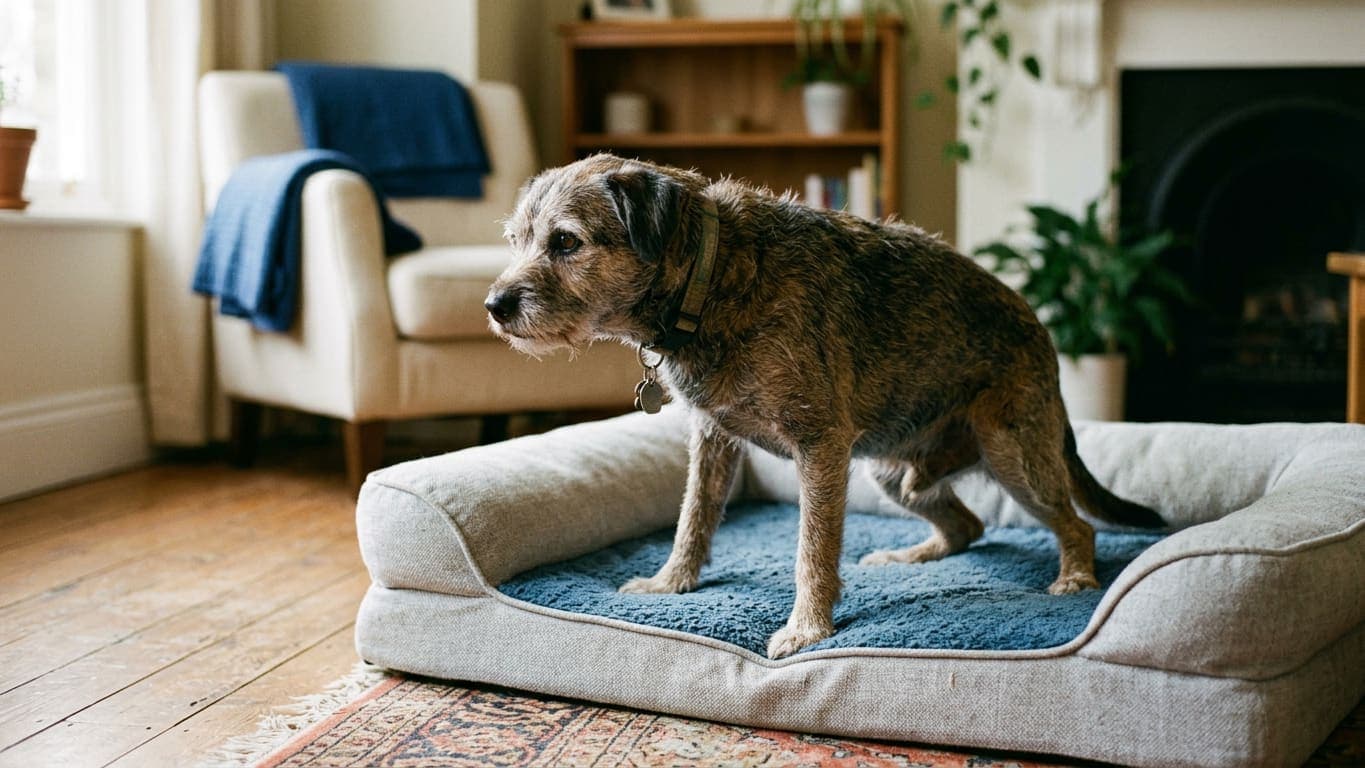
Your dog is slower on the stairs. Takes a moment longer to get up off the floor. Doesn't jump into the car the way they used to. Most owners file this under "getting old."
Very often it is not age. It is pain — and it is treatable.
Osteoarthritis is one of the most common conditions in older dogs and one of the most under-treated, for a simple and cruel reason: dogs are extremely good at hiding it. There is no limp until it is bad. There is just a dog doing slightly less, slightly more slowly, and an owner who assumes that is normal.
What arthritis actually is
Joint cartilage — the smooth surface letting bones glide — wears down. Bone rubs on bone, the joint becomes inflamed, and the inflammation drives further damage. It is progressive and it is painful, and the pain itself makes things worse: a sore dog moves less, loses muscle, puts more strain on the joint, and gains weight. That loop is the real enemy.
Signs worth taking seriously (any of these, in a dog over about six):
- Slow to rise, especially after sleeping
- Reluctance on stairs, jumping, or into the car
- Shorter walks, lagging behind, stopping earlier
- Stiffness that eases once they warm up
- Licking a joint, or new irritability when touched
- Sleeping more — which owners almost always read as ageing
What actually helps — ranked by evidence
This list is unglamorous and it works.
1. Weight control. The single most powerful intervention, and it is free. In the landmark lifelong Labrador study, lean-fed dogs not only lived a median of about 1.8 years longer than their overfed littermates, they developed osteoarthritis later and less severely (Kealy et al., JAVMA, 2002). Every excess kilo is load on a damaged joint. Nothing you can buy competes with this.
2. Pain control, properly prescribed. Veterinary NSAIDs are the backbone of arthritis management and they work. More recently, anti-NGF monoclonal antibodies (bedinvetmab) have given vets a monthly injectable option with good trial support for canine osteoarthritis pain. Never give human painkillers — paracetamol and ibuprofen are dangerous to dogs.
3. Controlled exercise and physiotherapy. Movement maintains the muscle that supports the joint. The goal is regular, moderate, low-impact activity — not weekend sprints. Hydrotherapy suits many dogs well.
4. Environment. Non-slip flooring, a ramp instead of a jump, an orthopaedic bed, raised bowls. Small changes, real daily difference.
5. Adjuncts with weaker evidence. Omega-3 fatty acids have reasonable support. Glucosamine and chondroitin are hugely popular and the evidence is, honestly, mixed to weak — we would rather say that than sell it to you.
Now the rapamycin claim
Here is what is being said, and you have probably read a version of it: that by damping systemic inflammation and cartilage breakdown, rapamycin improves mobility and reduces stiffness in older dogs.
There is no controlled trial of rapamycin for canine osteoarthritis. None.
The mechanism is not silly — mTOR signalling is involved in cartilage biology, chondrocyte behaviour, and inflammatory pathways, and there is preclinical work in rodent joint models. But "plausible mechanism" and "works in dogs" are separated by exactly the kind of trial nobody has run. This site exists partly to keep those two things apart, and we have a standing example of why: spermidine had a beautiful autophagy mechanism and still failed its largest human cognitive trial.
What about the broader longevity case? The 2017 randomized trial in 24 pet dogs looked at heart function and tolerability, not joints. TRIAD — the large trial now running — tracks mobility and activity among its measures, so an answer may eventually exist. It does not exist today.
The honest ranking
If your dog is stiff and slowing down, the interventions with real evidence are: get the weight off, get proper pain relief from your vet, keep them moving, and adapt the house. Those change your dog's life this month.
Rapamycin is a prescription drug being studied for ageing broadly, without arthritis-specific evidence in dogs. It is a reasonable thing to be curious about and an unreasonable thing to substitute for pain management. A dog in untreated joint pain does not need a geroscience compound; it needs analgesia.
See the full claim-versus-evidence breakdown for dogs, or run the evidence quiz to see which studies actually apply to your animal — and what to ask your vet.
Not veterinary advice. If your dog is slowing down, have them examined; pain is treatable and under-treated.
References
- Kealy R.D. et al. Effects of diet restriction on life span and age-related changes in dogs. JAVMA, 2002. Find on PubMed
- Lascelles B.D.X. et al. Bedinvetmab (anti-NGF monoclonal antibody) for canine osteoarthritis pain. Find on PubMed
- Urfer S.R. et al. A randomized controlled trial to establish effects of short-term rapamycin treatment in 24 middle-aged companion dogs. GeroScience, 2017. Find on PubMed
Compounds in this article
- Rapamycin (sirolimus)Emerging evidenceStudied for healthy aging, cardiac function, and immune resilience. A prescription drug — veterinary supervision is not optional.
The content on this site is for informational purposes only and is not veterinary advice. These statements have not been evaluated by a food or drug regulatory authority and are not intended to diagnose, treat, cure, or prevent any disease. Always consult a licensed veterinarian about your pet's health.