The old cat yowling at 3am: feline cognitive dysfunction and the ageing brain
If your senior cat has started crying at night, disoriented, it is frightening and exhausting. Here is what feline cognitive dysfunction is, what else it might be, and where the ageing-brain science honestly stands.
Our Beloved Friends Research · July 16, 2026 · 10 min read
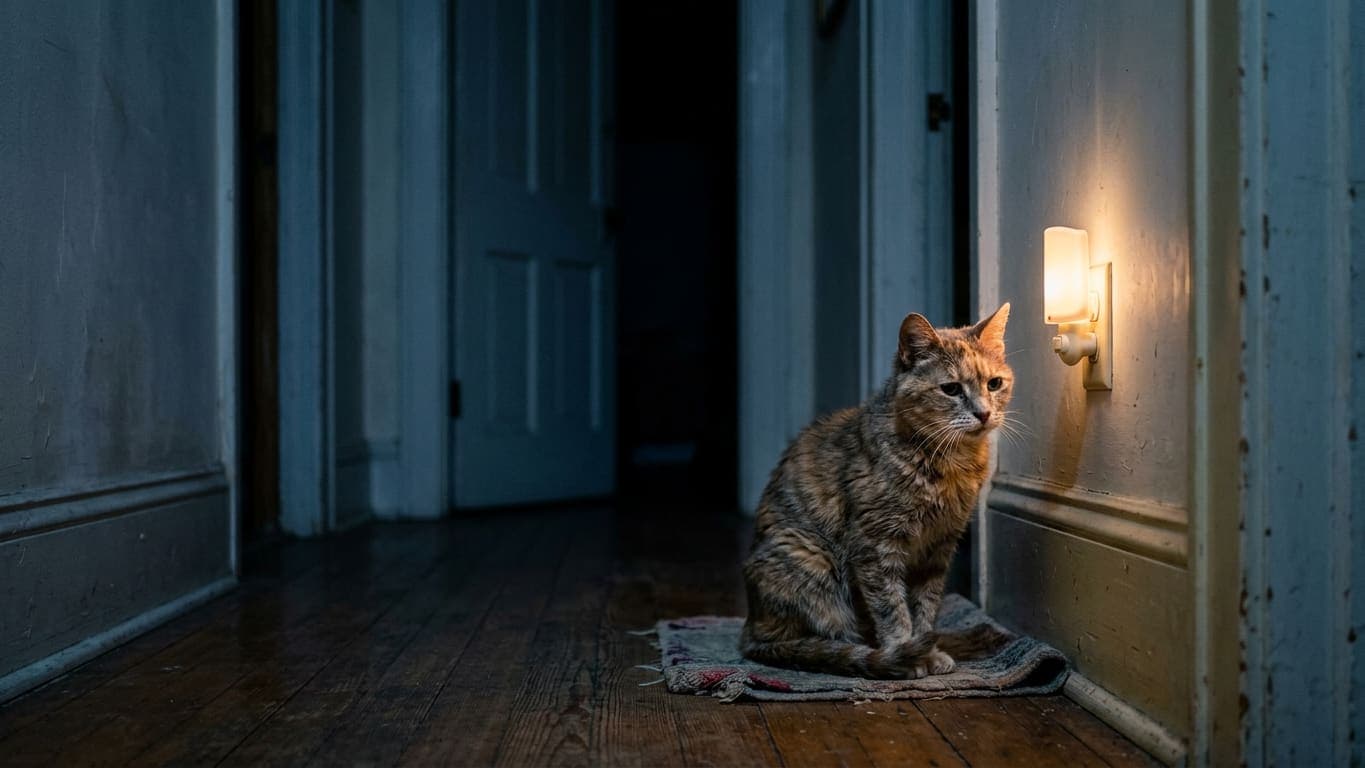
It is 3am, and your old cat is standing in the hallway crying — a loud, lost, insistent yowl at nothing. You come out, and they look at you as though they are not quite sure how they got there. It is one of the most distressing things a cat owner experiences, precisely because it feels like the cat is slipping away while still in the room.
You searched this in the dark, so let me start where it helps most: this is common in old cats, it has a name, and — importantly — several of its causes are treatable. Do not assume the worst before the vet has looked.
First, rule out the things that are not "just ageing"
The single most important message in this article: night-time yowling and disorientation in an old cat is not automatically dementia. Several very treatable conditions produce exactly these signs, and missing them means missing a fix.
- Hyperthyroidism — extremely common in older cats, and a classic cause of restlessness, vocalising, and night-time activity. A simple blood test finds it, and it is treatable.
- High blood pressure — often secondary to kidney or thyroid disease, and it can cause disorientation and, if unchecked, sudden blindness. A blind cat yowls because it is frightened and lost.
- Pain — arthritis is massively under-diagnosed in cats, because they hide it. A cat that hurts moving may cry, especially at night.
- Kidney disease and other systemic illness — feline CKD and other conditions disrupt sleep and behaviour.
Any of these can masquerade as "my cat is going senile." So the first step is not a supplement or a search result. It is a veterinary work-up — bloodwork, blood pressure, a proper look. Get that before concluding anything.
What feline cognitive dysfunction actually is
When the treatable causes are excluded, what remains is feline cognitive dysfunction (FCD) — the cat equivalent of the age-related cognitive decline seen in dogs and, in some respects, in people. It becomes markedly more common with age, and it is genuinely under-recognised because owners write the signs off as ordinary ageing.
Clinicians often summarise the signs with the shorthand DISHAA: Disorientation, altered Interactions, changes in Sleep-wake cycle (the 3am yowling), House-soiling, altered Activity, and Anxiety (Gunn-Moore, on feline cognitive dysfunction; Sordo & Gunn-Moore, feline cognitive decline). Under the hood, the ageing feline brain shows changes with unsettling parallels to human Alzheimer's — including accumulation of amyloid — alongside oxidative damage and failing cellular housekeeping.
Where the longevity science honestly touches this
This is where an honest site has to be careful, because it is exactly the point at which hope outruns evidence.
The through-line between brain ageing and the geroscience we cover is autophagy — the cell's self-cleaning process. Neurons are long-lived and cannot simply be replaced, so they depend heavily on clearing out damaged proteins; when that housekeeping falters with age, debris accumulates. Autophagy decline is a plausible part of the ageing-brain story, and it is the mechanism behind several compounds we cover.
But look at what happened when that mechanism met a trial. Spermidine, one of the best-characterised autophagy inducers, was taken into a rigorous human trial for cognition — and it did not deliver the hoped-for benefit (Schwarz et al., SmartAge). We wrote about that as a cautionary tale, and it is the honest note to strike here too: the mechanism connecting longevity science to the ageing brain is real and interesting, and the outcome evidence — even in humans, let alone cats — is not there. There is no rapamycin trial for feline dementia. Anyone selling you a cognitive cure for your cat is ahead of the science.
What genuinely helps an old cat's brain
While the frontier stays unproven, the practical support is real and worth doing:
- Treat the treatable causes — this cannot be repeated enough. Thyroid, blood pressure, pain, kidneys.
- Environmental support — night lights for a disoriented cat, easy-access litter trays, predictable routine, keeping the layout stable, gentle enrichment in the day to improve sleep at night.
- Diet and veterinary options — there is some evidence for diets and supplements aimed at brain ageing (antioxidants, certain fatty acids), and your vet can advise on what is reasonable versus hopeful.
- Your patience — a frightened, disoriented old cat needs reassurance, not frustration, even at 3am. Especially at 3am.
The honest close
Your cat crying in the dark deserves a real explanation, not a guess and not a supplement bought in panic. Very often that explanation is treatable, and even when it is cognitive dysfunction, there is genuine support to give. What there is not — yet — is a longevity drug proven to fix the ageing feline brain.
Start with the vet. Our evidence quiz will help you organise what to ask, and flag which of your cat's signs point somewhere specific.
Not veterinary advice. Please have an ageing cat with these signs examined by your veterinarian.
References
- Sordo L., Gunn-Moore D.A. Cognitive dysfunction in cats: a syndrome we used to dismiss as 'old age'. Journal of Feline Medicine and Surgery, 2021. Find on PubMed
- Gunn-Moore D.A. et al. Cognitive dysfunction and the neurobiology of ageing in cats. Journal of Small Animal Practice. Find on PubMed
- Schwarz C. et al. Spermidine supplementation in subjective cognitive decline (SmartAge). Find on PubMed
Compounds in this article
- SpermidineEmerging evidenceSupports cellular renewal (autophagy).
The content on this site is for informational purposes only and is not veterinary advice. These statements have not been evaluated by a food or drug regulatory authority and are not intended to diagnose, treat, cure, or prevent any disease. Always consult a licensed veterinarian about your pet's health.