When is a dog or a cat actually “senior”?
Not at seven, and definitely not by multiplying anything by seven. Dogs age on a curve set by their adult body size; cats do not. Here are the real thresholds — and why the answer decides whether the aging research applies to your animal at all.
Our Beloved Friends Research · July 15, 2026 · 9 min read
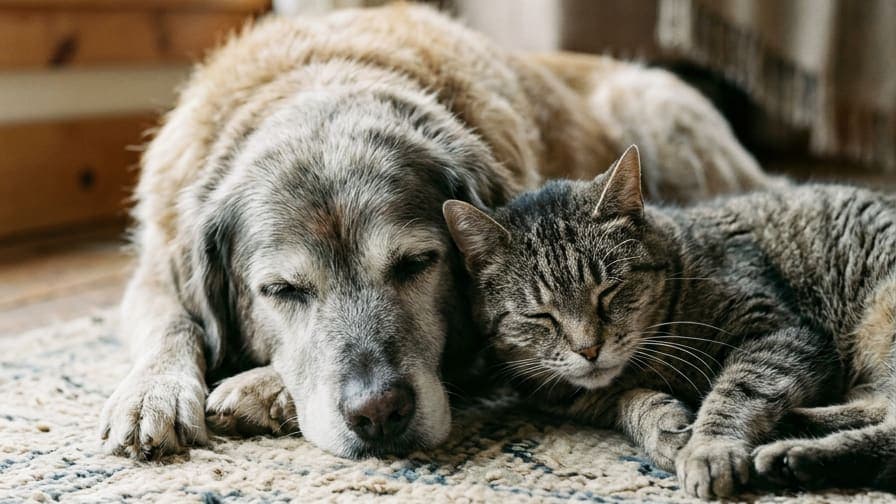
The "one dog year equals seven human years" rule is one of the most durable pieces of nonsense in pet ownership. Nobody knows who started it. It is wrong in an interesting way, and the way it is wrong tells you something real about how animals age.
Why the seven-year rule fails
A one-year-old dog is not seven. A one-year-old dog can reproduce, has a full adult skeleton, and has completed a developmental arc that takes a human roughly eighteen years. Meanwhile a twelve-year-old dog is not eighty-four in any meaningful sense.
Aging is not linear. It is fast at the start and then it settles.
In 2020, researchers compared DNA methylation — the chemical marks that accumulate on the genome with age, and which form the basis of "epigenetic clocks" — between dogs and humans. The relationship they found was logarithmic, not linear. Their translation formula was:
human equivalent ≈ 16 × ln(dog age) + 31
Run it and a one-year-old Labrador lands around 31 human years. A four-year-old around 53. A twelve-year-old around 71. That curve — steep, then flattening — matches how dogs actually live far better than multiplying by seven ever did.
Two honest caveats, since this is the sort of number that escapes into the world and never comes back. The study was built largely on Labrador Retrievers, and, as we are about to see, breed size changes everything. Treat it as a much better rule of thumb, not a birth certificate.
Dogs: size decides almost everything
Here is the strange fact at the centre of canine aging. Across species, bigger animals generally live longer — an elephant outlives a mouse by decades. Within the dog species, the relationship flips completely. Big dogs die young.
A Chihuahua may reach fifteen or sixteen. A Great Dane that reaches eight has had a good run. Same species. Same genome, more or less. The difference is growth — and the growth-hormone and IGF-1 signalling that drives it feeds directly into the same nutrient-sensing machinery, mTOR, that the entire longevity field is built around.
So "senior" is not a single number for dogs. Roughly:
| Adult size | Senior from about |
|---|---|
| Small (under 10 kg) | 10–11 years |
| Medium (10–25 kg) | 8–9 years |
| Large (25–40 kg) | 7–8 years |
| Giant (over 40 kg) | 6 years |
A six-year-old Great Dane and a six-year-old Jack Russell are not the same animal in any way that matters. One is entering the last quarter of its life; the other is in its prime.
This is not trivia. It is why the Dog Aging Project's TRIAD trial enrolled large-breed senior dogs, and why the first serious commercial attempt at a canine longevity drug, Loyal's programme, targeted big dogs first. If you want to see an effect on lifespan in a reasonable number of years, you study the dogs whose clocks run fastest. It is also, more bluntly, where the need is greatest.
Cats: a different, kinder curve
Cats do not do this. A Maine Coon is enormous and does not die meaningfully earlier than a domestic shorthair. Body size simply does not drive feline lifespan the way it drives canine lifespan, and nobody fully knows why.
The commonly used feline life stages are straightforward:
| Stage | Age |
|---|---|
| Kitten | under 1 year |
| Young adult | 1–6 years |
| Mature adult | 7–10 years |
| Senior | 11 years and up |
Note where "mature adult" starts: seven. That is the number worth holding on to, because seven is also roughly when the diseases that kill old cats — chronic kidney disease, hyperthyroidism, hypertrophic cardiomyopathy — begin to appear while the cat still looks entirely fine. A seven-year-old cat is not old. A seven-year-old cat is the right cat to start screening.
Why the label actually matters
This is not vocabulary. It changes what the science has to say about your animal.
Every meaningful trial in this field dosed animals in middle age or later. The 2009 mouse study that opened the whole field started rapamycin at 600 days — the rough equivalent of starting a human at sixty. The randomized trial in 24 pet dogs enrolled middle-aged dogs. The transient-dosing work in mice gave a three-month course in middle age and saw a durable effect.
Nobody has studied giving these compounds to a still-growing animal, and there is a good mechanistic reason not to: mTOR is a growth pathway. Inhibiting growth signalling in an animal that is still growing is not a clever early start. It is an experiment nobody has run, on your puppy.
So the practical translation is:
- Still growing — the research does not apply to you yet, and that is fine.
- Adult — read now, decide later. Nothing is urgent.
- Mature — this is the window every trial in the field actually studied.
- Senior — the population TRIAD enrolled. The mouse data suggests starting late is not futile.
And the line we will not soften, at any life stage: no drug has been shown to extend the lifespan of a dog or a cat. TRIAD is still running. Anyone who tells you otherwise is telling you something they do not know.
The unglamorous part that works
While you wait for the science — and you should wait for the science — the interventions with the best evidence for more good years are free or nearly so. Keep them lean. Look after their teeth. Keep them moving. Screen the blood of a seven-year-old cat and an eight-year-old large-breed dog before anything looks wrong.
None of that is exciting. All of it has better data behind it than any molecule in our compound library.
Work out where your animal actually sits
Our evidence quiz computes the life stage properly — by species, by size, by age — and then tells you which studies genuinely apply to your animal, what should stop a longevity conversation cold, and what to ask your veterinarian. Five questions, and it recommends nothing.
Not veterinary advice. Talk to your veterinarian about your animal.
References
- Wang T. et al. Quantitative translation of dog-to-human aging by conserved remodeling of the DNA methylome. Cell Systems, 2020. Find on PubMed
- AAHA Canine Life Stage Guidelines. aaha.org
- AAFP/AAHA Feline Life Stage Guidelines. catvets.com
- Kraus C., Pavard S., Promislow D.E.L. The size–life span trade-off decomposed: why large dogs die young. The American Naturalist, 2013. Find on PubMed
- Harrison D.E. et al. Rapamycin fed late in life extends lifespan in genetically heterogeneous mice. Nature, 2009. Find on PubMed
The content on this site is for informational purposes only and is not veterinary advice. These statements have not been evaluated by a food or drug regulatory authority and are not intended to diagnose, treat, cure, or prevent any disease. Always consult a licensed veterinarian about your pet's health.