Why big dogs die young
Across species, bigger animals live longer. Within the dog, it flips: a Great Dane is old at six while a terrier is barely middle-aged. The reason runs straight through the pathway the whole longevity field is built on.
Our Beloved Friends Research · July 16, 2026 · 9 min read
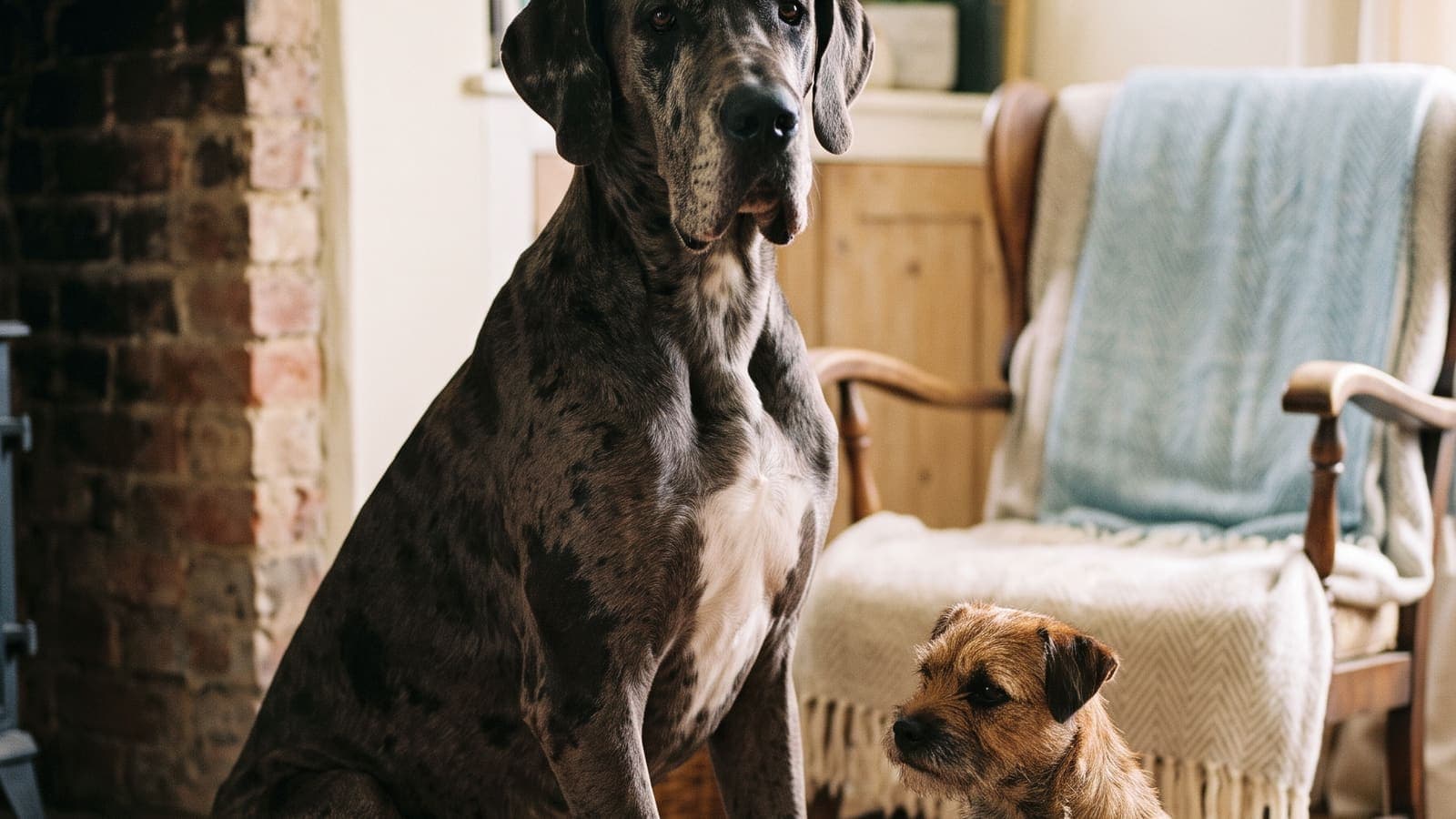
Here is one of the strangest facts in biology, and every owner of a big dog already knows it in their bones: large breeds die young.
A Chihuahua can reach sixteen. A Great Dane that sees eight has had a full life. Same species, essentially the same genome — and yet the giant breeds are old while the small ones are barely greying. Understanding why is not just consolation. It tells you something real about ageing, and about why the longevity research targets the dogs it does.
The paradox: across species vs. within one
Compare between species and size predicts long life. An elephant outlives a mouse by decades; whales live longer still. Bigger generally means slower-living and longer-lived.
Now look within the dog species and the rule inverts completely. The biggest breeds have the shortest lives. Researchers analysing large datasets of dog longevity found a clear cost to size: within dogs, every increase in body size carries an increase in the pace of ageing and a shorter life (Kraus et al., The American Naturalist, 2013). Big dogs, in the memorable framing of that work, seem to live their lives faster and age in fast-forward.
Two different rules, two different levels. The between-species rule is about evolutionary history. The within-dog rule is about what we did to dogs.
What we did to dogs
Every breed, from teacup to mastiff, was shaped from the wolf by humans in an eyeblink of evolutionary time. We selected the giant breeds for size by pushing hard on the body's growth machinery — and growth is not free.
The central player is the growth hormone / IGF-1 axis. Small dog breeds carry genetic variants associated with low IGF-1; large breeds run high. High growth signalling builds a big dog fast — and IGF-1 feeds directly into the same nutrient-sensing pathway, mTOR, that decides whether cells grow or repair themselves.
Turn the growth signal up for years and you get size, and you get a cost: faster cellular ageing, earlier onset of the diseases of old age, and in the giant breeds a brutal cancer burden. The thing that made the dog magnificent is the thing that shortens its life.
This is not a curiosity off to the side of longevity science. It is the same lever, in the same pathway, that the whole field is trying to move.
Why this decides who gets studied
Follow the logic and you arrive exactly where the research went.
If ageing runs faster in big dogs, then big dogs reach the diseases of old age sooner — and a trial can read out an effect on healthspan or lifespan in a realistic number of years rather than a decade or more. That is not the only reason to study them, but it is a decisive practical one.
So it is no accident that the Dog Aging Project's TRIAD trial — the definitive test of whether rapamycin extends canine lifespan — enrolled older, large-breed dogs. Nor that the first serious commercial attempt at a canine longevity drug, Loyal's programme, started with big dogs specifically, and has openly discussed IGF-1 as a target. The animals whose clocks run fastest are where you look first — and, not incidentally, where the need is greatest.
What it means for your dog
If you share your life with a big dog, the arithmetic is not kind, and pretending otherwise helps nobody. A Great Dane is a senior at six; a giant breed at five is not "still young." That is precisely why the age at which the ageing research becomes relevant to your dog arrives earlier than most owners expect — and why we compute senior status by size, not by a flat number.
And the honest limit still holds, for big dogs as for small: no drug has been shown to extend the lifespan of a dog. TRIAD is running. The mouse data is real and the mechanism is fascinating, but the result that matters to your Dane does not exist yet.
What does have evidence, and matters more for a large breed than for any small one, is unglamorous: keep them lean, because in a landmark lifelong study leaner dogs lived meaningfully longer; screen early; manage joints; watch for the cancers their breed is prone to. That is where the good years are actually bought today.
Our evidence quiz uses your dog's size and age to work out where they sit and which studies genuinely apply.
Not veterinary advice. Talk to your veterinarian about your dog.
References
- Kraus C., Pavard S., Promislow D.E.L. The size–life span trade-off decomposed: why large dogs die young. The American Naturalist, 2013. Find on PubMed
- Greer K.A. et al. Statistical analysis regarding the effects of height and weight on life span of the domestic dog. Research in Veterinary Science, 2007. Find on PubMed
- Sutter N.B. et al. A single IGF1 allele is a major determinant of small size in dogs. Science, 2007. Find on PubMed
- Kealy R.D. et al. Effects of diet restriction on life span and age-related changes in dogs. JAVMA, 2002. Find on PubMed
Compounds in this article
- Rapamycin (sirolimus)Emerging evidenceStudied for healthy aging, cardiac function, and immune resilience. A prescription drug — veterinary supervision is not optional.
The content on this site is for informational purposes only and is not veterinary advice. These statements have not been evaluated by a food or drug regulatory authority and are not intended to diagnose, treat, cure, or prevent any disease. Always consult a licensed veterinarian about your pet's health.